About this sample
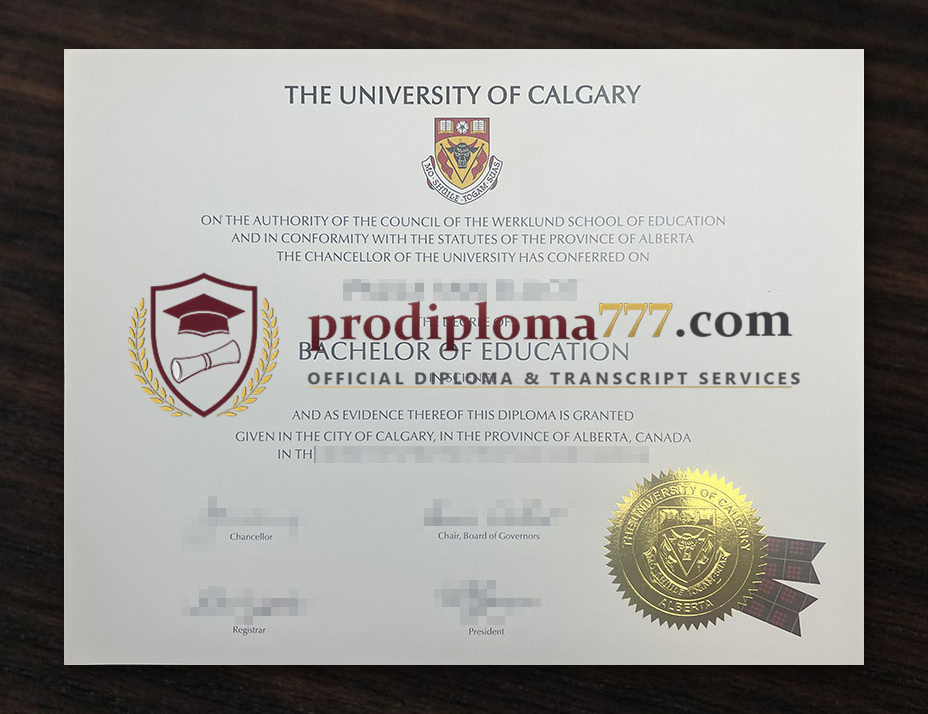
A University of Calgary parchment carries its authority in the body of the paper and the relief of its heraldry rather than in its text. Its material character is legible through three layers: a security-grade substrate, a tooled coat of arms, and a seal that shifts between foil and impression depending on the era of issue.#University of Calgary diploma,University of Calgary dgree,University of Calgary certificate.
The Paper Substrate
The parchment stock follows the heavier end of Canadian university practice. Industry guidance for post-secondary documents identifies 72-pound parchment paper as the weight matching “real university diplomas,” a stock chosen for stiffness and dimensional stability rather than for ordinary printing. Beyond weight, the substrate is a security paper: a sheet engineered during manufacture with embedded fiber and chemical features that make reproduction attempts physically visible, rather than a plain laser stock. The paper’s scale is inferred from the one documented UCalgary diploma held in an archival collection: a 21.2 × 27.5 cm sheet from 1967, a portrait format close to a folded broadsheet rather than a letter page. Contemporary graduate accounts describe the stock as thick and weighty, with surface detail finished to a standard that reads as ceremonial rather than administrative.https://prodiploma777.com/samples/canada-diplomas
The Heraldic Tooling
The纹路 on a Calgary parchment descend from arms granted in 1966 by the Lord Lyon King of Arms in Edinburgh. The shield is divided by an arched line representing the Chinook arch. The upper chief is scarlet—a reference to the North West Mounted Police—and carries a pair of open books bound in gold, with a white rose of Alberta set between them. The base is gold, bearing a black bull’s head with red horns and crossed staves with red flags, drawn from the family crest of Lt. Col. J.F. Macleod, the founder of Fort Calgary. Below the shield, an escroll carries the motto “Mo shúile togam suas” (“I will lift up my eyes”) in Gaelic uncial lettering. On the parchment, these elements are not flat ink. The books, the bull’s head, and the escroll are rendered in a tooled register—relief pressing or foil lifting—so that the heraldry registers as an object with depth, its gold and scarlet catching light against the matte paper.
The Seal and Its Material Shift
The seal is the parchment’s authenticating instrument, and its physical form has changed across the document’s history. The 1967 archival diploma records a gold foil seal applied to the sheet, accompanied by a tartan ribbon—a fixing that was both decorative and materially distinct from the paper. The university maintains an academic seal reserved for official documents such as academic credentials and transcripts, alongside the coat of arms used in ceremonial contexts. Contemporary physical descriptions note a laser security label among the surface features of the modern parchment. The result is a surface with contrasting tactile and optical registers: the grain of the security paper, the relief of the tooled arms, the reflective lift of residual foil, and the flat precision of a security label—each producing a different response when the document is tilted, pressed, or held to light. The parchment is, materially, a sheet engineered to be authenticated by hand before it is read by eye.