About this sample
The Material Craft of a St. Clair College Diploma
A St. Clair College diploma derives its physical authority from the surface of the document rather than from its text. Its material character is built from three overlapping elements: a heraldic device rendered in relief, a paper substrate chosen for ceremonial permanence, and a seal whose impression is felt before it is seen.#St Clair College diploma,St Clair College degree,St Clair College certificate.
Heraldic Tooling and Texture
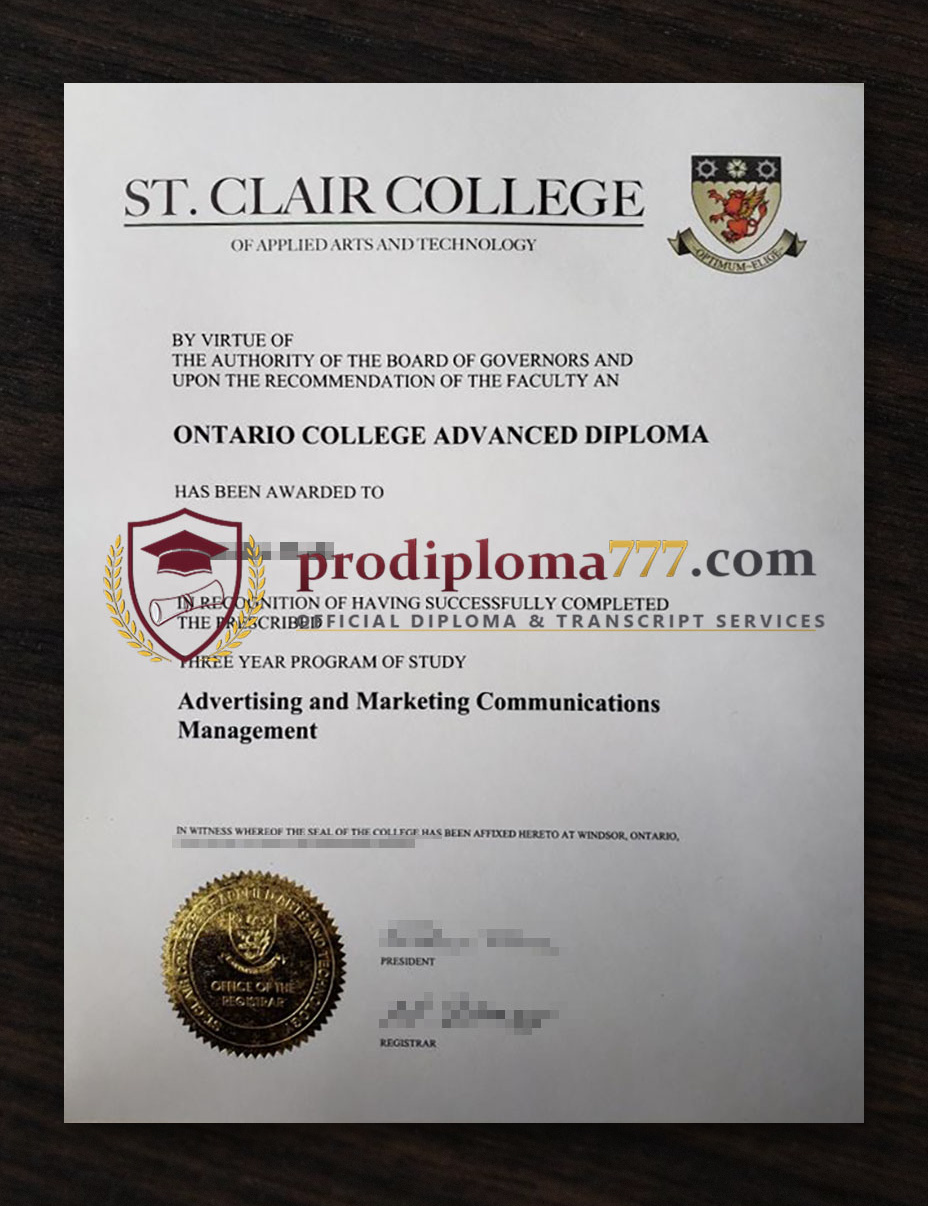
The decorative linework on a St. Clair diploma descends from arms registered with the Canadian Heraldic Authority. The central figure is a griffin segreant—rearing, red, with beak, wings, and forelimbs armed in gold—set against a silver field. Above it, on a black chief with a scalloped lower edge, sits a white rose flanked by two white cogwheels. The College’s formal palette is green, white, and gold. On the certificate, these elements are not flat ink. They are tooled: the griffin may be blind-embossed so that the form is read through shadow and fingertip rather than colour, or lifted in gold foil so that the armed forelimbs and the chief’s detailing catch light selectively against the matte ground. The rose and cogwheels sit within the same tooled register, their small scale requiring die-cut precision and giving the surface a second, tactile layer of information.
Paper Substrate
The diploma is printed on a parchment-style stock heavier than ordinary office paper, selected for the stiffness needed to hold a pressed seal without buckling and for dimensional stability within a frame over time. The certificate’s scale is best inferred from the frames made for it: St. Clair diploma frames are sized at approximately 16.50 inches high by 26.00 inches wide for the Chatham campus format, while a separate Windsor-format frame accommodates a smaller document within a 27 × 19 inch outer frame. The larger broadsheet proportion points to paper chosen as a panel rather than a page—a surface wide enough for the heraldic device to read as an object rather than an illustration. The stock carries a muted grain, a laid or lightly textured surface that establishes a tactile baseline before the eye reaches the foil or the embossing.
Seal and Surface Security
The seal follows the tradition of blind embossing rather than printed reproduction. A die is pressed into the paper under pressure, raising the device in relief without ink; the impression is read through shadow and touch and does not survive photocopying intact. This logic extends to the broader security repertoire of Canadian post-secondary documents: watermarks formed during paper manufacture rather than printed on top, guilloche linework whose interlocking geometry degrades under reproduction, and microtext embedded in borders. St. Clair College does not publish a feature-by-feature inventory of its current stock, but the physical result follows the document’s ceremonial function. The diploma is a surface engineered to be tilted, pressed, and held up to light before it is read—a paper object whose authenticity is registered first by the hand, then by the eye.