About this sample
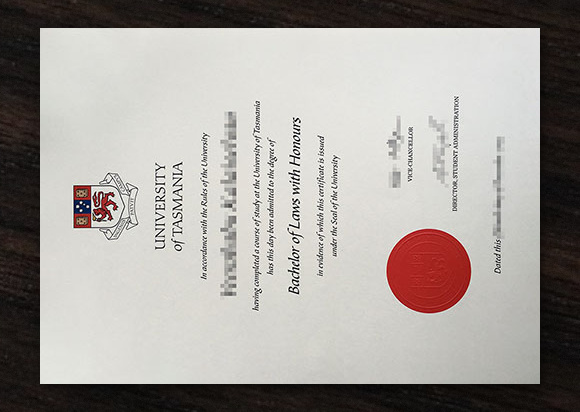
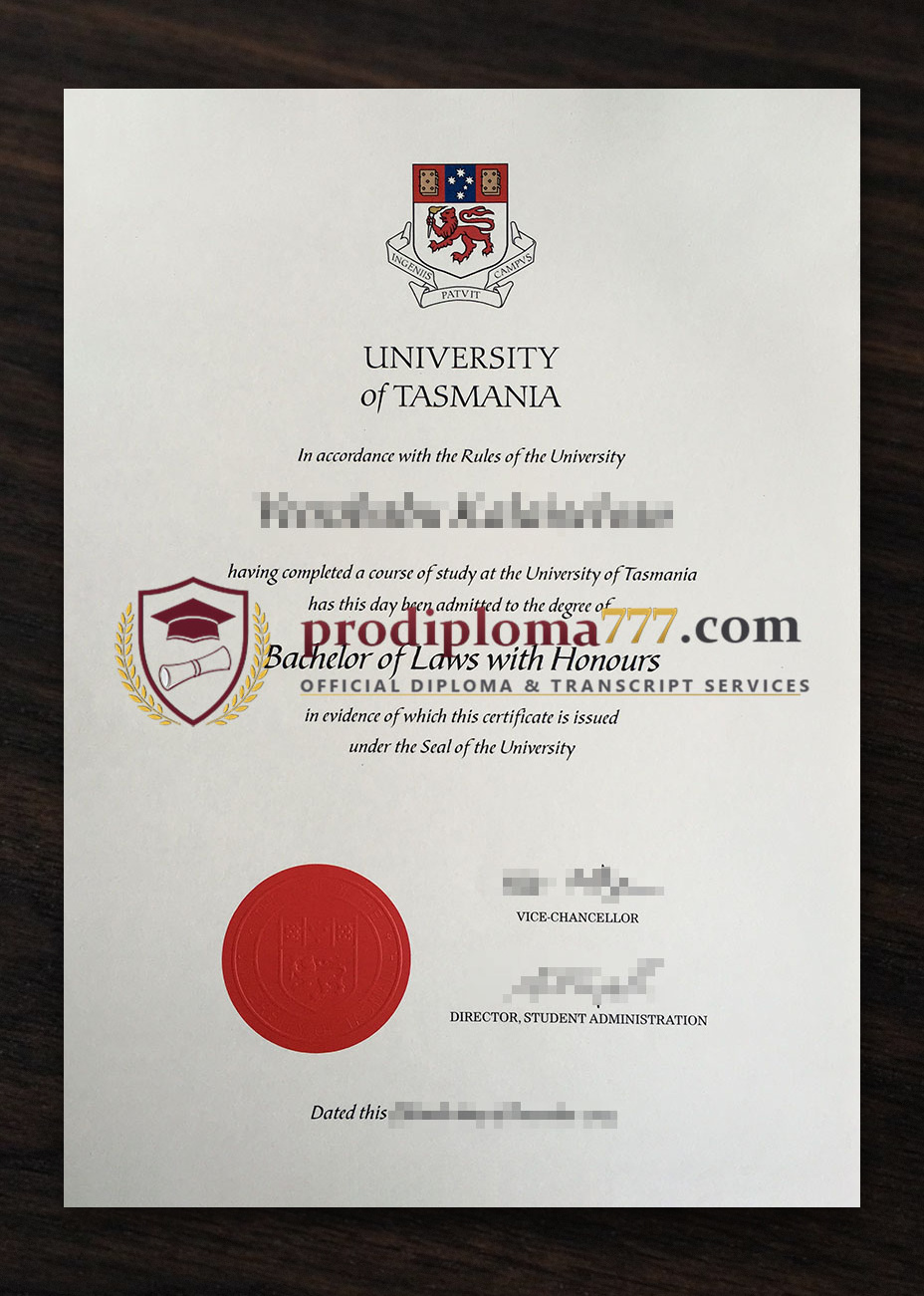
The University of Tasmania’s testamur carries a physical authority that is easier to feel than to read. Its material character rests on a heraldic inheritance, a paper substrate selected for endurance, and a surface engineered against reproduction.#University of Tasmania diploma,University of Tasmania degree,University of Tasmania certificate
The Arms and the Seal
The tactile centre of gravity is the heraldic device. The University’s arms were designed in 1938 by E. Kruger Gray, the artist recommended by the University of Western Australia and commissioned after a 1936 competition. The design holds four legible elements: a lion passant (the Tasmanian symbol), a torch (equality), the Southern Cross (location), and an open book (knowledge). The motto, Ingeniis Patvit Campus—“the field lies open to talent and merit is sure of its reward”—was formally adopted in 1936, taken from a panegyric by the Roman poet Claudian. The arms appeared on certificates in colour well before they were formally granted by the College of Heralds in 1978, and the same device remains the visual anchor of the modern testamur.https://prodiploma777.com/samples/aus-diplomas
The seal operates by a different logic. Historically, the University’s Common Seal was not a decorative imprint but a legal instrument, used to seal property transfers and letters to the Monarch; it was not used as a logo. As late as 1951, testamurs carried no logo at all. The sealing of a testamur remains a formally recorded act: the Academic Registrar must record the sealing in the graduation roll, and the Vice-Chancellor and Academic Registrar attest to the sealing of a testamur under the University’s ordinance. The modern certificate therefore inherits a seal-function that is administrative in origin, pressed into the document’s surface as the final authenticating mark.
Paper and Substrate
The testamur is printed on secure paper, a baseline requirement for Australian higher education certification. The specific stock selected by the University of Tasmania is not publicly specified, but the physical format can be inferred from the frames manufactured for it: the University-approved testamur frames accommodate a document in the range of roughly 39.5 × 48.5 cm (outer frame dimensions), consistent with an A3 or near-A3 parchment sheet. Australian practice varies: while many institutions use A4, a number—including the University of Melbourne and ANU—print on A3, and Tasmania’s certificate fits within that larger ceremonial format. The substrate is heavier than standard office paper, selected for the stiffness required to carry a pressed seal and for the dimensional stability needed over decades of framing.
Texture and Security Tooling
The surface of the testamur is not a passive print layer. Australian higher education providers, including Tasmania, embed physical security controls into the certificate substrate and print. The recognised repertoire includes watermarks formed during paper manufacture rather than printed on top, guilloche patterns—interlocking geometric linework that degrades under photocopying—microtext, holographic elements, and embossed logos or seals. The University of Tasmania states that its testamurs carry security features, though it does not itemise which specific combination appears on the current stock. What is clear is the logic of the object: a paper chosen for permanence, a heraldic seal that descends from a legal instrument, and a surface that is meant to be tilted and touched as much as read. The testamur is, in material terms, a document designed to remain legible for longer than the career it certifies.