About this sample
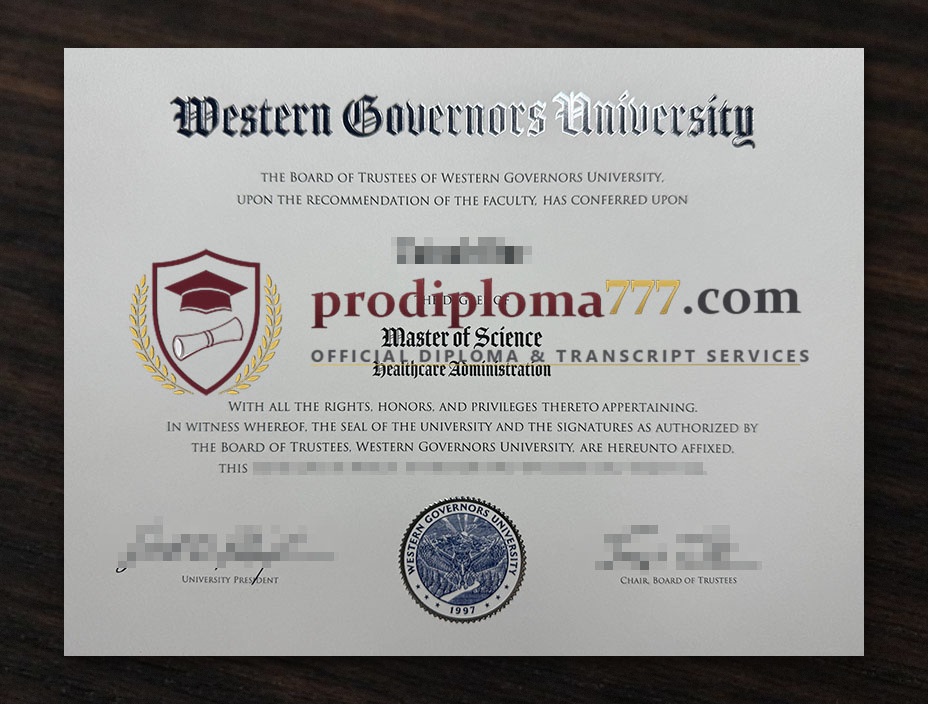
A Western Governors University diploma does not rely on the dense physical security tooling of a traditional residential institution. Its material logic is shaped instead by the university’s origins as an online, competency-based provider: the paper is standard and the validation is predominantly digital, leaving the academic seal to carry the document’s ceremonial weight as a printed, two-color device rather than a pressed or foil-lifted impression.#Western Governors University diploma,Western Governors University dgree,Western Governors University certificate.
The Paper as a Standard Sheet
WGU issues a complimentary physical diploma printed on letter-size paper, 8.5 inches tall by 11 inches wide, for all programs. Graduates may purchase an 11 × 14 inch copy if they prefer a larger format. The stock is therefore not a broadsheet parchment panel but a standard documentary sheet, selected for practical production rather than the stiffness required by a heavy embossed seal. WGU does not publish a paper weight or fibre specification, and its official policy describes the diploma primarily in terms of dimensions rather than substrate character. The material emphasis falls elsewhere: the digital CeDiploma, available since May 2024, is the credential the university presents as instantly validated, with the physical diploma serving as a ceremonial counterpart rather than the sole authenticating object.https://prodiploma777.com/samples/usa-diplomas
The Academic Seal and Its Two-Color Register
The纹路 on a WGU diploma are anchored in the academic seal, the device the university designates as “the university’s formal mark of academic authority” and the one used on diplomas and other official documents. Its central figure is an owl with wings outstretched past the seal’s inner circle, a deliberate breaking of the boundary that encloses conventional seals. Behind the owl sit mountain peaks and a brilliant sunrise, imagery the university reads as “bold achievements and new beginnings”. The seal is the only place in WGU’s visual identity where WGU Gold appears; the rest of the institution’s communications are governed by WGU Blue. The style guide is explicit: gold “should not be used in any other application”.
On the diploma, this seal is not described in official materials as blind-embossed or foil-stamped. It is a printed graphic produced in two specified spot colors, WGU Blue and WGU Gold. The material experience is therefore optical rather than tactile: the gold sits as a flat, calibrated ink layer against the sheet, and the seal’s authority is registered by the eye rather than by the fingertip’s encounter with relief. The wings extending beyond the inner circle create the seal’s most distinctive linework, a visual gesture that reads as an opening outward rather than a closed boundary.
The Absence of Surface Security Tooling
WGU does not document a repertoire of watermarks, guilloche patterns, or microtext on its physical diploma. The authentication strategy is bifurcated: the CeDiploma carries the instant validation function, while the paper document carries the ceremonial and archival function. This division explains the diploma’s material restraint. There is no pressed seal whose relief would require a heavier stock; there is no foil stamp whose reflection would demand a particular angle of light. The surface is instead a clean ground for the two-color seal and the document’s typography. The physical diploma is, in this sense, a printed artifact rather than a crafted object: its authority is conferred by the seal’s institutional designation and by the digital record that accompanies it, not by the depth of an impression or the grain of a parchment substrate.