
About this sample
A University of Pretoria diploma carries its authority in the body of the sheet rather than in its text. Its material character is legible through three overlapping registers: a parchment-referencing substrate, a heraldic device pressed into relief, and a seal whose presence is registered by touch before it is read.#University of Portsmouth diploma,University of Portsmouth dgree,University of Portsmouth certificate.
The Paper Substrate
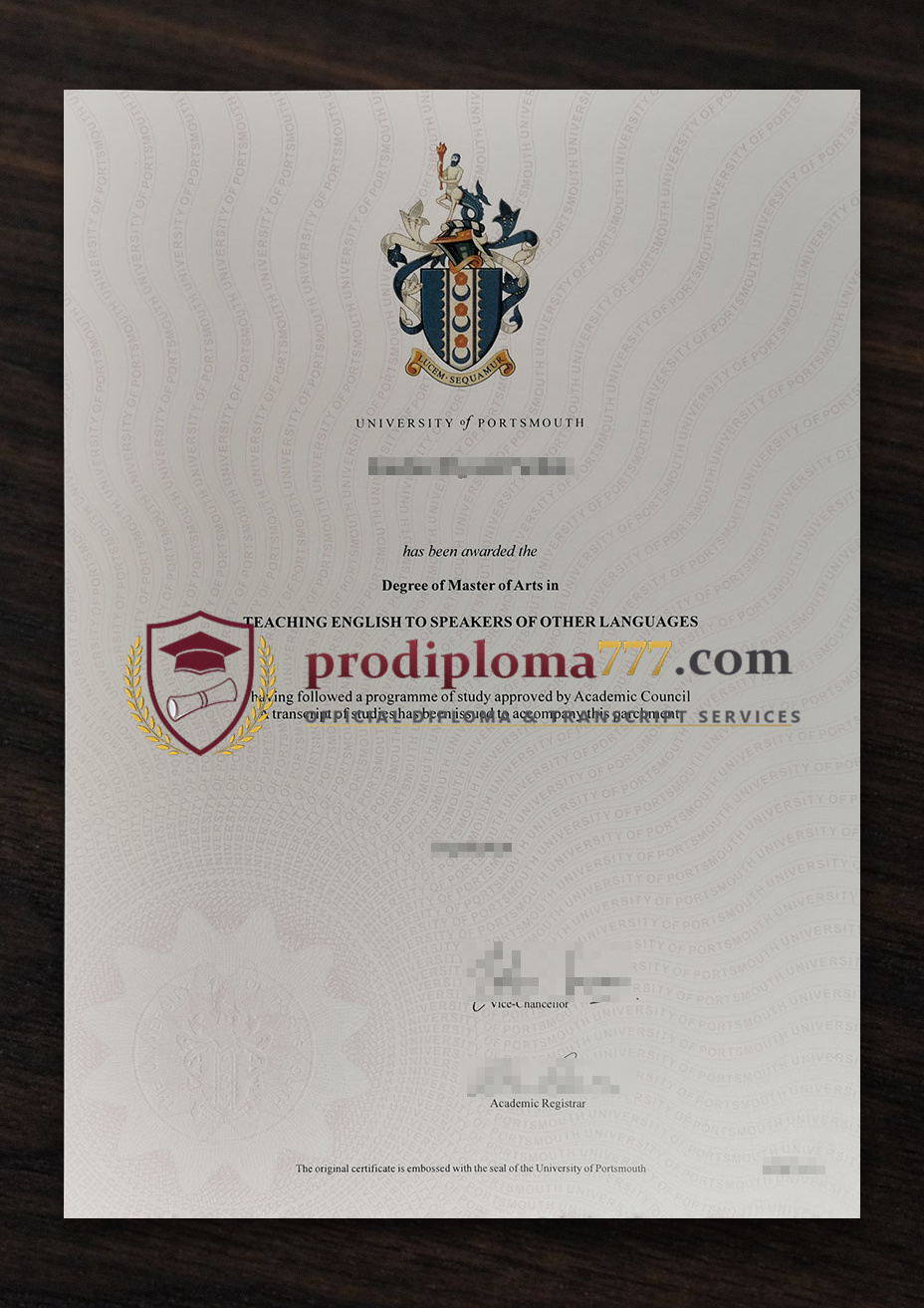
The stock follows a parchment tradition without attempting a literal imitation of animal skin. A University of Pretoria repository study on page design records a deliberate choice of “a light brown background… close enough to the colour of the parchment to give a sense of its warmth,” while reducing show-through to a level that does not interfere with legibility. This is a substrate tuned for the optical temperature of parchment rather than its surface irregularity: warm, matte, and stable under light, but smooth enough to carry fine heraldic detail without the grain of a true vellum competing with the die. The sheet is a security paper in the ordinary documentary sense—issued as an “Original Qualification Certificate” and held in safekeeping until collection—and South African university parchments are conventionally produced with embedded safety features that are compromised by lamination or surface treatment. The paper is therefore selected as a panel rather than a page: a surface wide enough for the ceremonial arms to read at object scale, and stiff enough to hold a pressed seal without buckling at the edge.https://prodiploma777.com/samples/uk-diplomas
The Heraldic Tooling
The texture on a UP diploma descend from arms that have remained substantially unchanged since 1908, deliberately insulated from the university’s changing operational logo. The shield is blazoned Per chevron Gules and Azure, a pall reversed between dexter three bees placed 1 and 2, sinister three annulets placed 2 and 1, and in base an ox-wagon, all Or, fimbriated Or. In material terms, this is a field divided by an inverted V, red above and blue below, carrying a Y-shaped pall, three bees on the left, three rings on the right, and an ox-wagon at the base, the whole charges rendered in gold and the shield edged in gold. The university’s formal palette is blue, gold, and red, a triad that governs the diploma’s visual temperature as surely as the heraldry itself. On the certificate, these elements are tooled rather than printed flat: the bees, the annulets, and the ox-wagon are pressed into relief by blind embossing, so that the form is encountered through shadow and fingertip before it is parsed as symbol, or lifted in gold foil so that the charges catch light selectively against the matte ground. The arms are the same ceremonial device that appears on degrees, diplomas, and certificates, and their tooling gives the surface a second, tactile layer of information independent of the printed text.
The Seal and Surface Security
The seal operates in the tradition of a fixed impression rather than a printed graphic. South African university practice applies a dry seal—an emblem pressed into the paper without ink—alongside tooled borders and engraved plates, so that the authenticating mark is read through relief and does not survive photocopying intact. The fixing of this seal is a formal act rather than a decorative flourish, and the resulting impression sits within the same material logic as the heraldic tooling: a recessed bite in the paper that responds to pressure and angle of light. Around this central impression, the broader repertoire of documentary security printing supplies the finer textures—guilloche linework whose interlocking geometry degrades into broken dots under reproduction, microtext embedded in borders, and watermarks formed during paper manufacture rather than printed on top. UP does not publish a feature-by-feature inventory of its current stock, but the physical result is consistent across these registers: the grain of the warm-toned paper, the relief of the tooled arms, and the bite of the dry seal each produce a different response when the document is tilted, pressed, or held to light. The diploma is, materially, a surface engineered to be authenticated by hand before it is trusted as a record.


